
Ads in AI assistants stopped being hypothetical in 2026: ChatGPT is testing them, Perplexity tried and walked away, Google runs them in Search AI but not Gemini, and Claude refuses them outright. What each platform actually shows, and why none of it lets anyone buy their way into the answer.
Yes, some of them, and 2026 is the year it stopped being speculation. OpenAI announced on 9 February 2026 that it was testing ads in ChatGPT, and by 11 August 2026 the test had expanded to the UK, Mexico, Brazil, Japan and South Korea. At the same time, Perplexity, the assistant that pioneered sponsored placements, shut its ad program down entirely. The market split, and the split is instructive.
This matters to a B2B company for one reason above all: the answer itself is still not for sale. Every platform running ads keeps them labeled and separated from the organic answer. Being the company an assistant recommends remains earned, not bought, and that is the part you can act on.
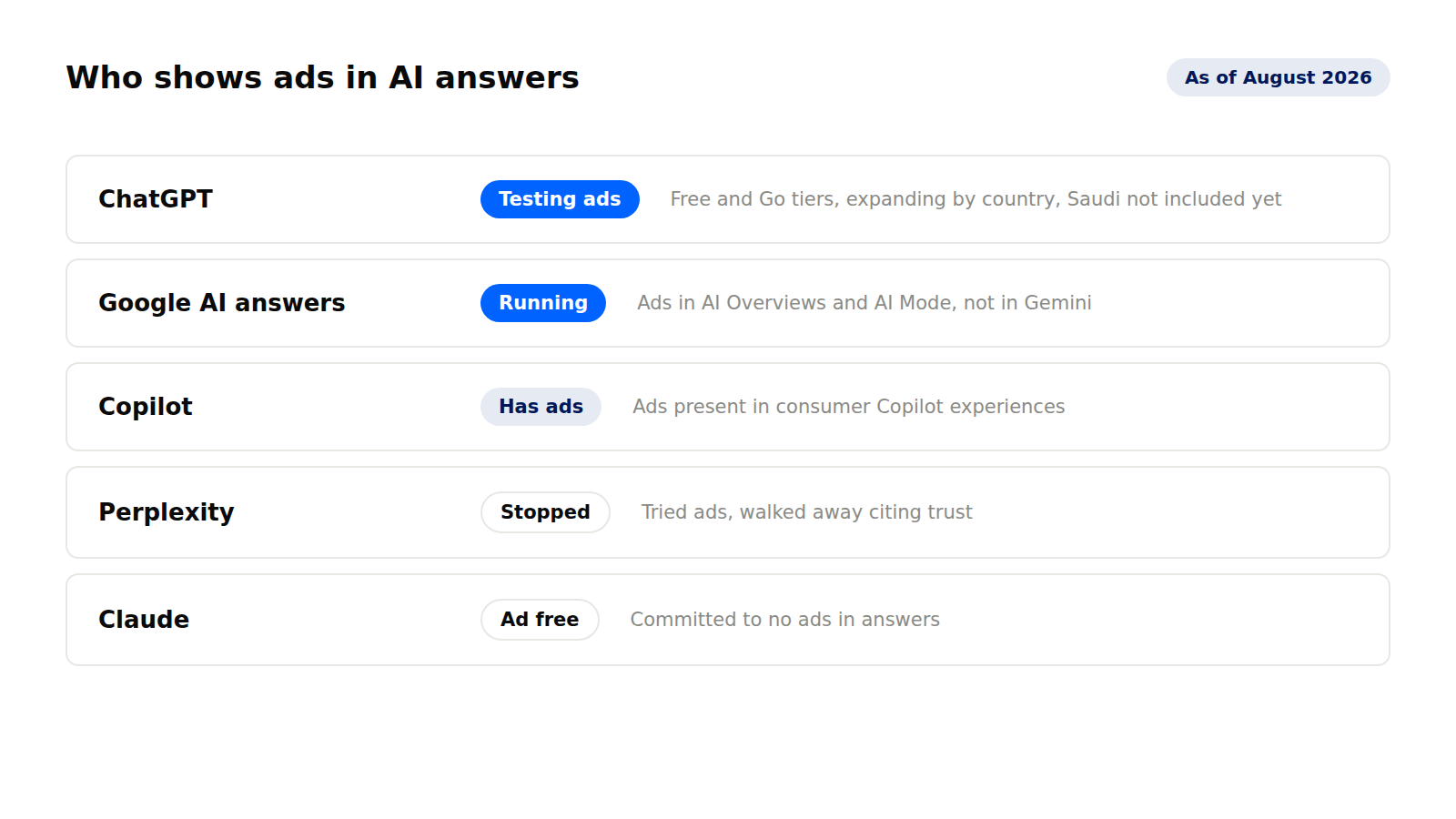
ChatGPT (OpenAI): testing, in selected countries. Ads appear only for the Free and Go tiers; Pro, Business, Enterprise and Education stay ad free. OpenAI states the ads are clearly labeled as sponsored, visually separated from the answer, and that ads do not influence the answers ChatGPT gives. Ads are excluded from sensitive topics, advertisers see only aggregate views and clicks, and free users can opt out in exchange for fewer daily messages. Saudi Arabia was not among the test countries at the time of writing.
Google: yes in Search, no in Gemini. Ads run in AI Overviews and AI Mode inside Google Search, and have for some time. The Gemini app itself carries no ads, and Google has publicly pushed back on reports that this will change, even after Adweek reported that advertisers had been briefed on a 2026 Gemini rollout. Treat Gemini ads as contested and unannounced.
Perplexity: tested, then stopped. After trialing sponsored follow-up questions since 2024, Perplexity phased ads out in 2026, saying that even clearly labeled ads risk making users doubt whether the answer is the truth or the monetization. Its revenue now comes from subscriptions.
Claude (Anthropic): committed ad free. Anthropic has publicly stated that Claude products will not carry ads and that it will not let advertisers pay for placement in conversations.
Microsoft Copilot: ads, and early. Microsoft brought its advertising business into Copilot from the start, with formats like Showroom ads built for conversational flows.
Nothing so far resembles a paid answer. The formats in the wild fall into three shapes: sponsored modules below or beside the answer, matched to the conversation topic; sponsored follow-up prompts, the format Perplexity tested and retired; and shopping or commerce placements where a purchase is the natural next step. The line every platform has held publicly is the same one: the organic answer is generated first, independently, and the ad sits next to it.
No. There is no platform, in any of the programs above, where payment changes what the assistant says when a buyer asks who to work with. That question, the one that matters commercially, is still decided by what the models can read and verify: your pages, your evidence, your consistency across the sources they trust.
That is worth sitting with, because it means the window is still open. When a Saudi buyer asks an assistant who builds industrial websites or who supplies packaging in Dammam, the companies named are the ones with quotable, verifiable material, and almost nobody in the market has done that work yet. Paid placement, when it arrives here, will sit beside those answers, not replace them.
Three things, in order. First, nothing about budgets yet: there is no self-serve AI ad platform available for Saudi advertisers today, and the ChatGPT test has not reached the region. Second, watch the two channels that already exist and already reach Saudi users: ads in Google AI Overviews and AI Mode run through Google Ads you may already be buying, so review where your campaigns appear. Third, and most valuable, invest in the organic side while it is uncontested: structured pages, real evidence, consistent entity information, in Arabic and English. That is the work we cover under generative engine optimization, and it is what determines whether the answer mentions you, ads or no ads.
In test markets, for free tier users, yes, since early 2026: labeled sponsored modules separated from the answer. Paid tiers see none, and the test had not reached Saudi Arabia at the time of writing.
No. Anthropic has publicly committed to keeping Claude ad free and not selling placement in conversations.
Every platform running ads states they do not, and the formats support that: the answer is generated independently and the sponsored unit sits beside it. The risk everyone is managing, and the reason Perplexity quit, is whether users believe it.
No such product exists on any major platform. Recommendations come from what the models read: your site, third party corroboration, and structured data. That is earned visibility, and it is the durable asset.
No platform has announced a date. OpenAI is expanding country by country, so it is a matter of when rather than if. Google ads inside AI Overviews already serve Saudi queries.
Make your pages worth quoting: direct answers, real numbers with dates, schema markup, and consistent information everywhere the models look. Start with an AI visibility audit to record what assistants currently say about you in both languages.
OpenAI, Testing ads in ChatGPT, announced 9 February 2026, expansion updates through 11 August 2026, openai.com. Search Engine Land, Perplexity stops testing advertising, 2026, citing the Financial Times. Adweek, Google tells advertisers it will bring ads to Gemini in 2026, with Google publicly disputing the report, 2026. Anthropic statement on keeping Claude ad free, anthropic.com. Microsoft Advertising documentation on Copilot ad formats.
Rida Alhashem
Founder, Leads
B2B marketing and lead generation specialist, with expertise in website development, search and AI visibility in the Saudi market.
inOther notes on getting found and getting inquiries in Saudi B2B.
Tell us what you sell and who buys it. We reply within one business day, with questions, not a pitch.


