.PNG)
ChatGPT Ads Are Coming

OpenAI has officially shared how advertising will be introduced inside ChatGPT, and it is a meaningful shift for performance marketers, brand teams, and media buyers. Not because it copies search ads. Because it changes where intent is formed, how recommendations appear, and what “high intent” looks like inside a conversational interface.
This post summarizes what OpenAI confirmed, what ad formats are shown in their examples, and how to prepare your marketing stack for ChatGPT advertising when it expands beyond the U.S.
What OpenAI announced, specifically
OpenAI says it plans to begin testing ads in the coming weeks in the U.S. for logged in adult users on the Free tier and ChatGPT Go. The initial placement will be at the bottom of answers, only when there is a relevant sponsored product or service based on the current conversation.
Key rollout details that matter for media planning:
- Ads are not live yet. OpenAI describes this as testing, and states ads are currently not in ChatGPT.
- Where ads appear: bottom of answers, clearly labeled, separate from the organic response.
- Who will not see ads: Plus, Pro, Business, Enterprise (and Edu, per the Help Center).
- Sensitive topics: ads are not eligible to appear near health, mental health, politics, and similar sensitive or regulated topics.
- Under 18: OpenAI says it will not show ads when a user indicates or is predicted to be under 18.
- User controls: users can learn why they saw an ad, dismiss it, and control personalization, including clearing data used for ads.
The principles that shape how ads will work in ChatGPT
OpenAI published “ads principles” that are unusually explicit compared to other ad platforms. For marketers, these principles hint at what will be allowed, what will be measured, and what will not be negotiable.
1) Answer independence (this will shape creative and claims)
OpenAI states ads will not influence the answers ChatGPT gives. Ads will be separate and clearly labeled. That signals a likely separation between “ranking” of the answer and “eligibility” of an ad placement. In practice, marketers should expect no “pay to be the recommendation” model, at least by stated policy.
2) Conversation privacy (this will shape targeting and reporting)
OpenAI says it will keep conversations private from advertisers and will not sell user data to advertisers. That typically implies reporting will lean toward aggregated performance, and targeting will rely heavily on contextual signals rather than personal identity graphs.
3) Choice and control (this affects reach and personalization)
Users can turn off personalization, and OpenAI says it will “always offer a way to not see ads,” including paid ad free tiers. For advertisers, reach may be smaller than traditional social platforms, but intent quality may be higher.
4) Long term value (optimize for trust, not time spent)
OpenAI explicitly says it does not optimize for time spent. That is a warning to marketers who rely on engagement hacks. Expect an environment that rewards usefulness, specificity, and relevance.
What the first ChatGPT ad formats look like (based on OpenAI’s examples)
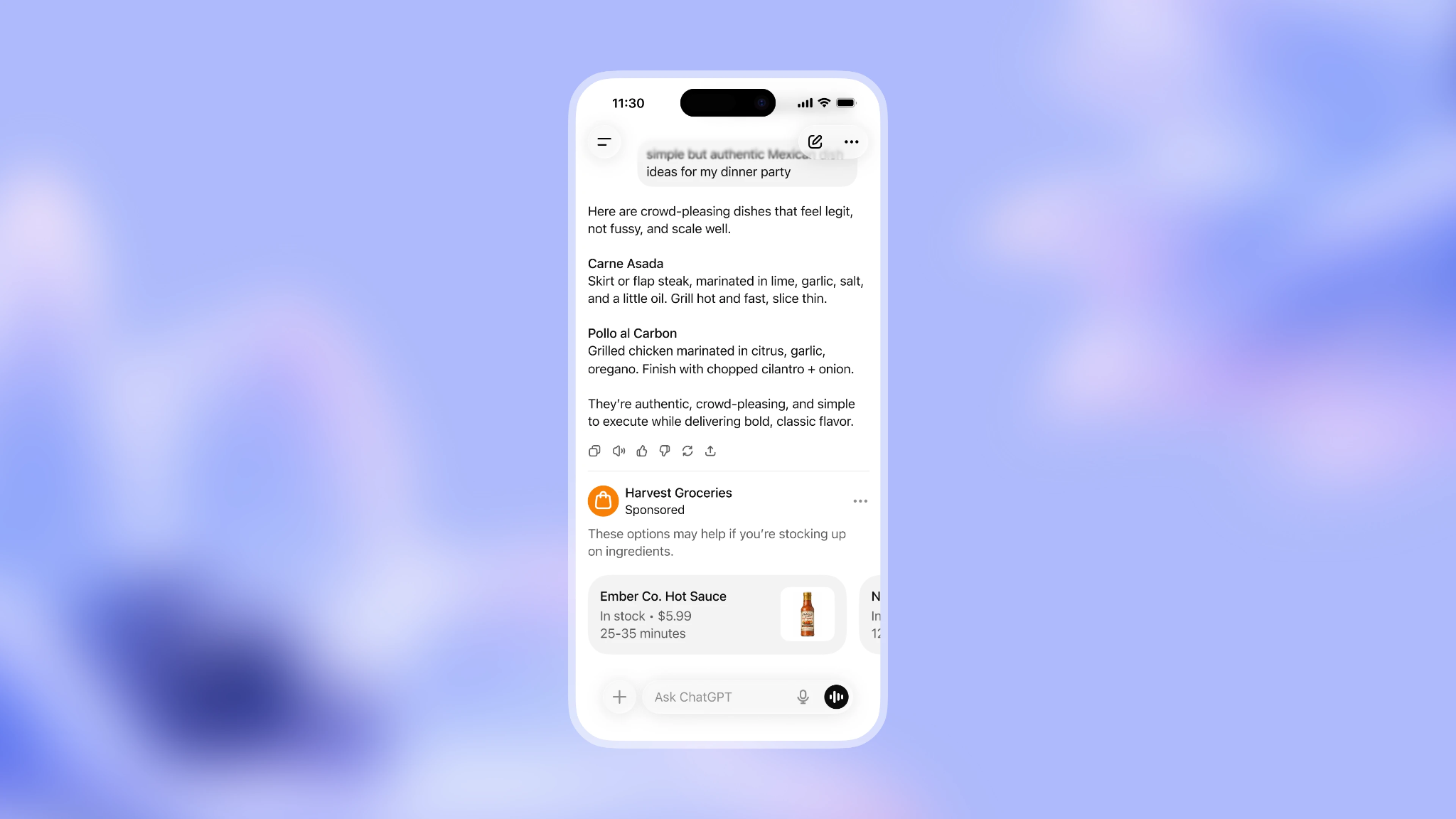
OpenAI included two mockups worth studying because they show the product direction clearly.
A user asks for dinner party recipes. The response is organic, then a sponsored module appears below it with a brand name, “Sponsored” label, and a specific purchasable item. This looks closest to a “sponsored product” unit rather than a text ad.
A user asks about travel to Santa Fe. A sponsored listing for a lodging brand appears, then the user can continue the conversation, potentially asking questions directly to make a decision. OpenAI explicitly suggests ads could become interactive, letting users ask questions to evaluate a purchase.
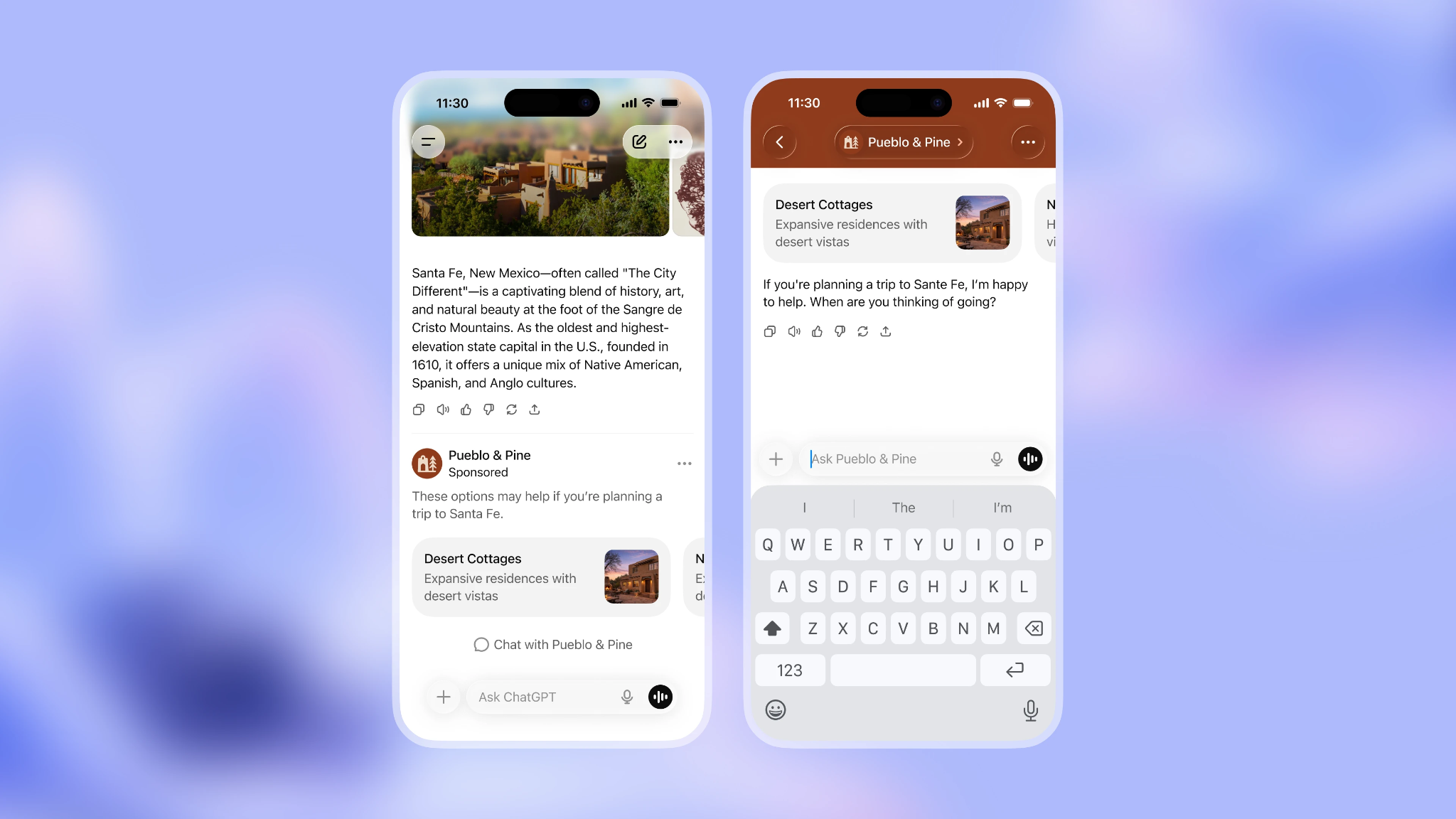
This is the real opportunity for marketers. The ad is not just a click. It is a guided decision flow.
What this means for marketers and advertisers
1) ChatGPT ads will compete with search intent, not social attention
In ChatGPT, the “moment of intent” happens inside a conversation. If your category wins inside these moments, you influence consideration earlier than the search results page, and potentially with higher context.
2) Contextual relevance becomes the primary targeting lever
OpenAI’s wording emphasizes relevance to the current conversation, plus optional personalization controls for users. Start planning around intent clusters, not demographics.
Practical implication: build campaigns around prompts and scenarios, for example:
- “Compare options” prompts.
- “Best for my use case” prompts.
- “What should I buy” prompts.
- “Plan my trip” prompts.
- “Shortlist vendors” prompts.
3) Your landing experience must be “conversation ready”
If OpenAI evolves toward interactive ads, your content cannot be only a landing page headline and a form. You will need:
- Clean product facts and specs.
- Transparent pricing logic (even ranges).
- FAQs, objections, and comparisons.
- Proof assets that are easy to cite or summarize.
4) Measurement will likely start simple, then evolve
OpenAI has not published an advertiser console or reporting spec yet, and the Help Center says they will share more after early testing. So marketers should prepare to run early experiments with conservative expectations: learn fast, validate incrementality, and avoid over committing budget assumptions before inventory expands.
How to prepare now, before ChatGPT ads expand internationally
If you want to be an early mover when ChatGPT ads become available outside the U.S., explain what to do now.
Audit your “high intent” content
- Build pages that answer “should I choose X or Y”.
- Publish comparison pages you are proud of.
- Create structured FAQs that AI systems can summarize reliably.
Define your prompt to product map
- List the top 30 to 100 queries that lead to purchase decisions in your category.
- Group them into 5 to 10 intent clusters.
- Align each cluster with one clear value proposition and proof set.
Prepare brand safety and compliance
Ads are excluded from sensitive topics in early testing. Build category specific exclusions and review guidelines so your campaigns highlight allowed benefits without drifting into restricted claims.
Plan a test budget and learning agenda
Your first goal will not be ROAS at scale. Your first goal will be learning:
- which intent clusters trigger eligible ad moments
- what messaging feels “useful” inside chat
- what post click journey converts without friction
Want to be ready for ChatGPT ads in Saudi Arabia and the region?
At Leads, we are building a ChatGPT advertising readiness playbook for brands that want early mover advantage once OpenAI expands ad inventory beyond the U.S. This includes intent mapping, creative strategy for conversational placements, testing design, and measurement frameworks based on what OpenAI has confirmed so far.
.jpg)


