

Most bilingual sites treat Arabic as an afterthought: a machine-translated copy bolted onto an English design. We build both languages to the same standard, because your buyers switch between them and judge you in each.
Native buyers spot machine translation in one sentence, and what it tells them is that they are not the audience you care about.
Flipped icons, misaligned menus, and numbers that fall apart. A design made for English rarely survives right-to-left untouched.
New pages ship in English first, and the Arabic version follows months later or never. Half your audience reads an outdated site.
Arabic searches are where much of the Saudi demand lives, and a translated page without Arabic SEO never appears there.
An Arabic font chosen as an afterthought next to a polished English one makes the same page feel like two different companies.
Without a CMS built for two languages, each change is made twice by hand, so one side inevitably drifts.
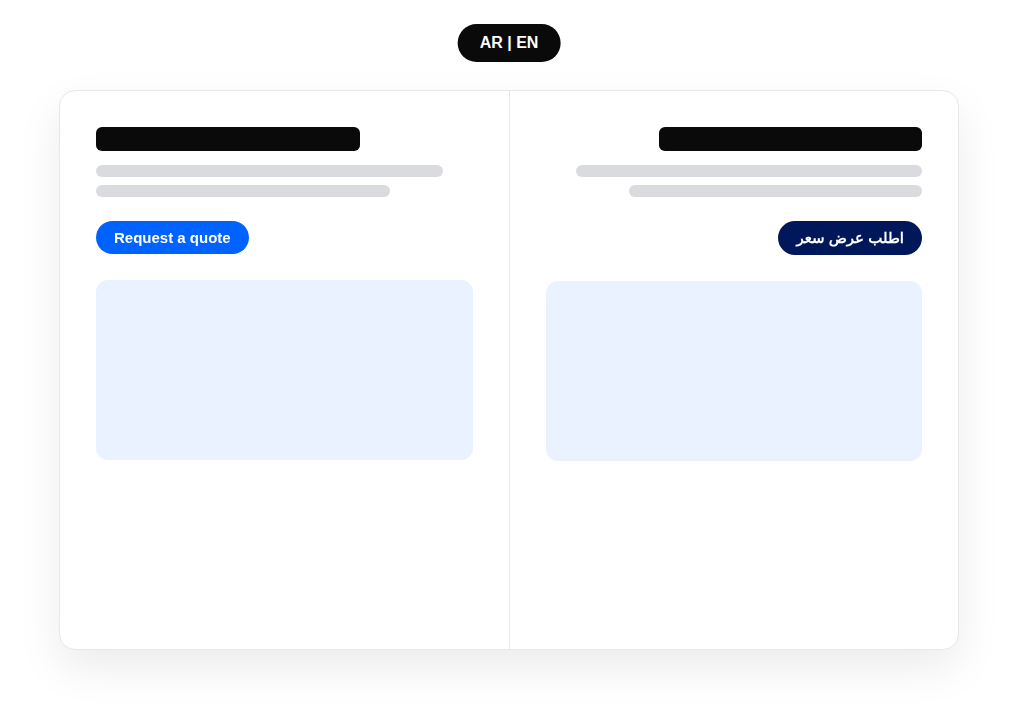
A proper bilingual website is two parallel versions of the same site, Arabic and English, each written by people in that language, each designed for its reading direction, and each optimized to be found by search engines and AI answers in that language. It is not a translation layer on top of an English site. The structure signals to Google which page serves which language, and the content is written once per language, not converted.
Six commitments that apply equally to the Arabic and English sides.
The Arabic side is designed for right-to-left reading, not mirrored by a script and patched after.
Arabic and English content each written by people who write in that language for business audiences.
Clean URLs, hreflang signals, and keyword work done separately for Arabic and English searches.
Your team updates both versions from one place, so neither side drifts out of date.
Arabic and English typefaces chosen together, so both pages carry the same brand weight.
Speed and mobile experience measured on both versions, because both audiences count.
Four steps, and the Arabic side is present in every one of them.
We decide what each audience needs page by page. Some pages mirror each other, some differ, and that is deliberate.
Layouts are designed LTR and RTL together, so the Arabic side is a first-class design, not a mirror with patches.
Arabic and English content are written side by side against the same brief, and each is reviewed by a native reader.
Speed, layout, forms, and search signals tested separately in each language before either goes live.
Pick one solution or take all five. We scope it, name every deliverable, and price it for what you actually need.
Whether we translate or write from scratch, how Arabic SEO differs, what a second language adds to scope, and how both sides stay in sync.
+
+
+
+
+
+
Tell us what you sell and who buys it. We reply within one business day, with questions, not a pitch.


