

How Saudi and GCC manufacturers turn a website, search visibility and disciplined follow-up into a steady flow of qualified RFQs: the ICP work, the spec-ready pages buyers need, the channels that produce inquiries, and a 90 day plan to get moving.
Qualified RFQs. Not impressions, not followers, not traffic: requests for quotation from buyers whose spec, volume and geography you can actually serve. Every recommendation in this guide is aimed at that one output, because it is the only marketing metric a plant manager or commercial director should be asked to care about.
The structural shift is simple to state. Most Saudi manufacturers still generate demand the outbound way: exhibitions, relationships, cold calls. Those still work, and we will cover how to make them work harder. What has changed is that procurement teams and engineers now search, compare and shortlist online before any call happens, in English for technical research and in Arabic to judge whether you are a serious local operator. A manufacturer visible at that moment gets into RFQ processes it would never have heard about otherwise.
Start with two or three ideal customer profiles, defined at the company level: the industries you serve best, plant or order size, geography, and the problem that makes them switch suppliers, whether that is delivery reliability, compliance or landed cost. Your best existing customers are the template: what do the profitable, repeat ones have in common?
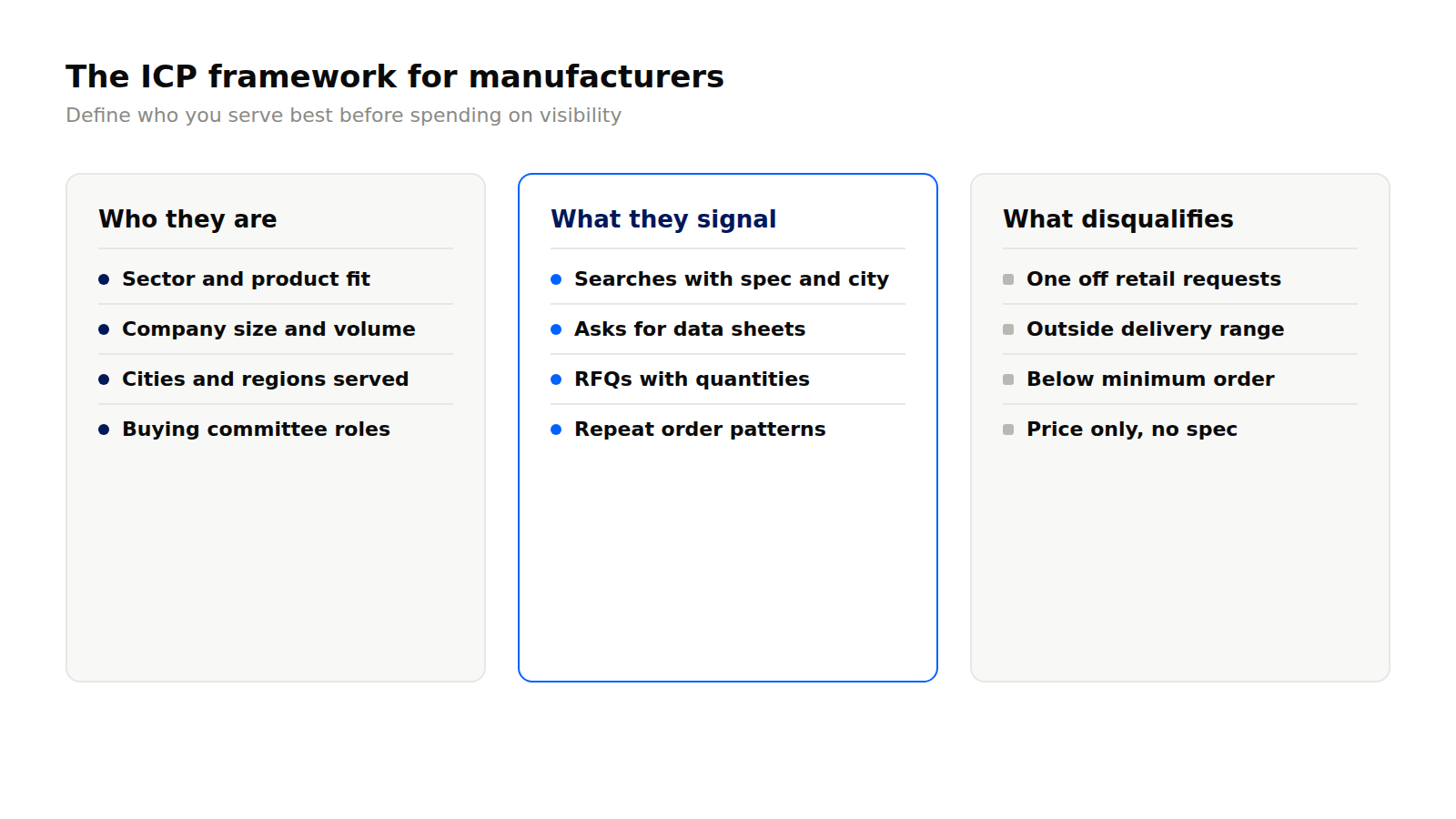
Then name the people inside the committee, because a manufacturer almost never sells to one person. The pattern we see across Saudi industrial buyers: an operations or procurement manager who initiates the search and cares about reliability, lead time and cost stability; and a technical or brand-side influencer who cares about specs, certifications and how the choice reflects on them. Your website has to answer both, which is why a single generic products page underperforms.
The website is the asset every channel below feeds into, and for a manufacturer it has a specific job: let a buyer verify capability and submit a spec without a phone call. That means:
Search, first. Buyers phrase demand precisely: product plus manufacturer plus place, alternative to an imported brand, ISO certified supplier of a material. Pages built around those phrasings, in both languages, compound for years, and the Arabic side is nearly uncontested. This is standard SEO applied with industrial discipline, and increasingly it is also what gets you named when a buyer asks an AI assistant for suppliers.
Google Ads, for the demand that exists today. Quotation-intent keywords, dedicated landing pages per product line, and tracking to the source. We wrote a separate practical guide to Google Ads for manufacturers.
LinkedIn, used narrowly. Not viral content: proof of life. Shipments leaving the plant, certifications renewed, machinery commissioned, posted consistently, plus direct outreach to procurement and engineering titles at a named list of 20 to 50 target plants, sequenced from a first touch to a capability deck to a sample offer to a site visit.
Exhibitions, with arithmetic. The stand pays back when meetings are booked before the show, visitors are qualified at the booth, and every qualified conversation gets a recap and next step within 48 hours. Without those three, it is brand spend, not lead generation.
A CRM with stages that match how manufacturers actually sell: inquiry, qualified, sampling or trial, price and terms, purchase order, repeat. Score inquiries against your ICP so sales time goes to the right ones. Review weekly what came in and what stalled, and measure the funnel in cost per qualified RFQ and win rate rather than clicks. The pattern that kills manufacturer pipelines is not a lack of inquiries; it is inquiries answered in four days instead of four hours.
Manufacturers that execute this sequence typically see pipeline effects inside the first quarter, because paid search captures existing demand immediately while the search and content work compounds behind it.
Keep both; they work. The change is that the buyers you have never met are searching right now, and the committee members behind your relationship contacts verify you online before signing. Digital lead generation adds the demand you currently never see, and protects the demand you already have.
Paid search: as soon as campaigns and pages are live. Organic: Arabic niches in two to four months, competitive English terms in six to twelve. The honest sequencing is paid for now, organic for the compounding.
The engineer researches in English; the committee judges you in Arabic. Both languages have a job, and the Arabic side is where visibility is cheapest because so few competitors have done it properly.
It varies by sector and ticket size, which is exactly why the number must be measured rather than assumed. Set up tracking so every RFQ traces to its source, then judge each channel on its own cost per qualified inquiry.
They can produce volume, usually price-driven and often outside your ICP. Treat them as a secondary channel, and never let a marketplace profile substitute for a website you own, because the marketplace owns those relationships.
Based on the lead generation methodology Leads applies with Saudi industrial clients, and the search behaviour patterns in our own client data. Channel guidance aligned with the current state of Google Ads and LinkedIn targeting as of August 2026.

Rida Alhashem
Founder, Leads
B2B marketing and lead generation specialist, with expertise in website development, search and AI visibility in the Saudi market.
inOther notes on getting found and getting inquiries in Saudi B2B.
Tell us what you sell and who buys it. We reply within one business day, with questions, not a pitch.


